OtherCountries
The best place to get your National University of Singapore certificate online.
diplomascopy.com
2026-10-23
8 min read
15
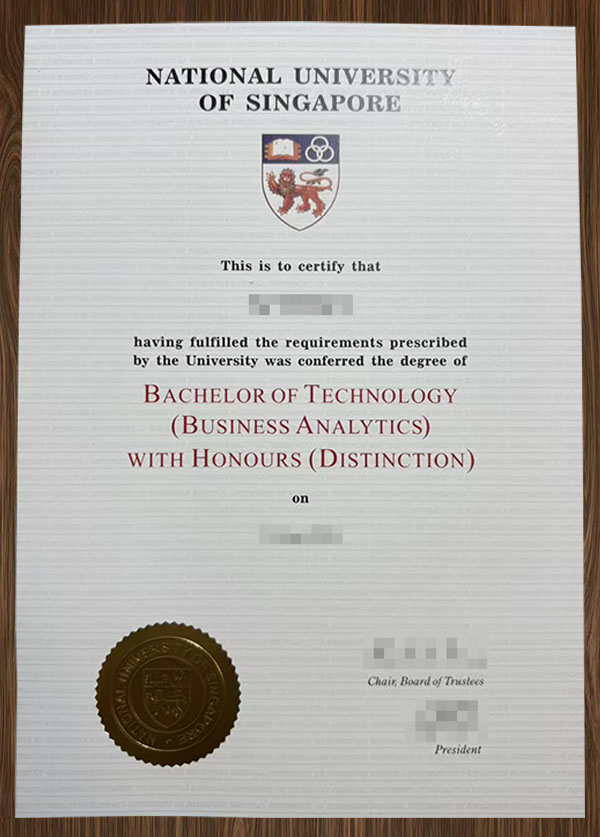
The National University of Singapore (NUS) is an institution that defies easy categorization. National University of Singapore certificate, National University of Singapore degree, National University of Singapore diploma. It is, by nearly every available metric, the leading university in Asia—ranked 15th globally in the Times Higher Education World University Rankings 2027, its highest position ever, while remaining third in Asia behind two Chinese institutions and first in Singapore. In the QS World University Rankings by Subject 2026, it placed 28 subjects in the global top ten, seven of them in the top three, the highest number of top-three entries of any university outside the United States and the United Kingdom . Yet NUS is not merely a ranking machine. It is a university with a specific origin story—founded by community leaders in 1905 to serve local needs—and a specific mandate as Singapore’s flagship institution, one that has shaped both its extraordinary ascent and the tensions that accompany it.
NUS’s roots lie in a modest medical school. In 1905, a group of businessmen led by Tan Jiak Kim founded the Straits Settlements and Federated Malay States Government Medical School with 23 students, responding to a community need for locally trained doctors. Perchase National University of Singapore certificate online, Novelty National University of Singapore degree online. The school became King Edward VII Medical School in 1913, and in 1928 Raffles College was established to provide tertiary education in the arts and sciences . The two institutions merged in 1949 to form the University of Malaya, which for a time served both Singapore and what would become Malaysia.
The political separation of Singapore and Malaysia produced two national universities. The University of Singapore was established on 1 January 1962, with its campus at Bukit Timah . Nanyang University, founded in 1955 through contributions from the Chinese community and affectionately known as “Nantah,” operated separately. The decisive moment came on 8 August 1980, when the University of Singapore and Nanyang University merged to form the National University of Singapore, consolidating at the 150-hectare Kent Ridge site. The merger was not merely administrative; it represented the newly independent nation’s determination to build a single, strong flagship university capable of serving its development ambitions.
Why are National University of Singapore certificate so popular?
The second tension concerns access and selectivity. NUS is intensely competitive, and its role as Singapore’s flagship means it attracts the nation’s strongest students. The university’s admissions processes are transparent in the sense that indicative grade profiles are published, but the pressure to gain admission is a feature of Singapore’s broader educational culture rather than something NUS alone creates or can resolve.
The fastest way to order a National University of Singapore certificate online. The question is whether a university that serves as the primary destination for the country’s academic elite can also function as a genuinely accessible institution. NUS’s financial aid enhancements and its commitment to ensuring overseas exposure regardless of means suggest an awareness of this tension, but do not eliminate it.
The National University of Singapore is best understood as a university that took a specific historical mandate—to serve a small, newly independent nation with no natural resources beyond its people—and turned it into a strategy for global excellence. Its founding by community leaders in 1905, its consolidation as a national institution in 1980, and its subsequent rise to the top tier of global rankings represent a coherent trajectory: build a university capable of meeting national needs, then build it well enough that it competes internationally on its own terms.
That strategy has succeeded by nearly any measure. NUS is now the highest-ranked university in Asia outside China, and its disciplinary breadth is extraordinary for an institution of its size and age. But the questions that accompany success are harder than those that accompany ambition. A university that has spent four decades proving it can compete globally must now decide what it is for beyond competition—how it balances national service with intellectual independence, excellence with access, and the useful with the speculative. Those are questions no ranking can answer, and they will define NUS’s next chapter more than any position on a league table.