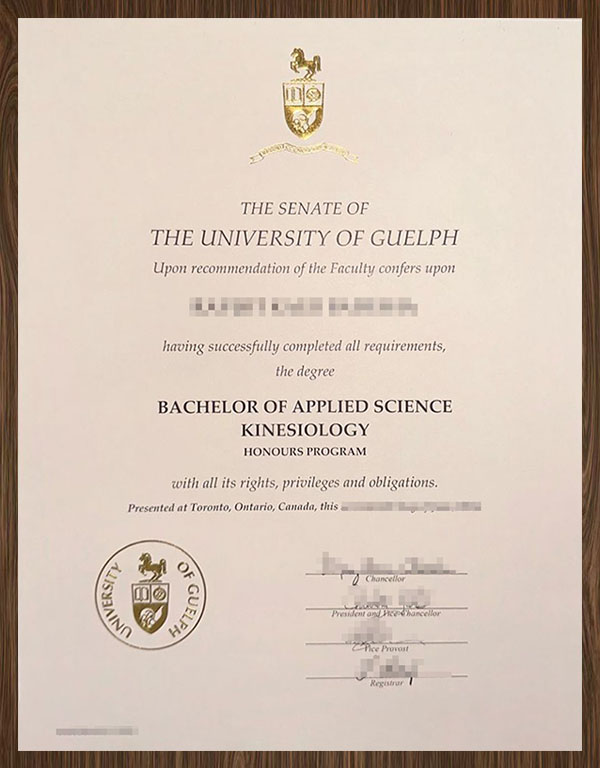
The University of Guelph occupies a position in Canadian higher education that is difficult to categorize neatly. University of Guelph degree, University of Guelph certificate, University of Guelph diploma. It is not a large metropolitan research university in the mold of Toronto or McGill, nor is it a small liberal arts college. It is, instead, a comprehensive institution of roughly 22,000 students with an unusual concentration of strength in a specific domain—food, agriculture, veterinary medicine, and the life sciences—that has shaped its identity since before it officially became a university.
Founded in 1964 through the amalgamation of three colleges with roots stretching back to 1862, Guelph has built a reputation that rests less on global ranking prestige than on a particular kind of impact: research that reaches farms, kitchens, veterinary clinics, and ecosystems in tangible ways. Novelty University of Guelph degree online, Replica University of Guelph diploma online. Its unofficial motto, “Improve Life,” captures something genuine about the institution’s self-understanding, even if such phrases often function as marketing[source:uoguelph.ca]. Understanding Guelph requires taking seriously the proposition that a university can be world-class in a domain that is often treated as peripheral to academic prestige.
The University of Guelph’s history is inseparable from the agricultural and veterinary institutions that preceded it. The Ontario Agricultural College (OAC), established in 1874 on a 500-acre farm near Guelph, was the province’s response to a need for practical agricultural education. The Ontario Veterinary College, North America’s oldest veterinary school, began in Toronto in 1862 before relocating to Guelph in 1922. The Macdonald Institute, founded in 1903, became a leading centre for domestic science education. When the Ontario government created the University of Guelph in 1964 by federating these three colleges and adding Wellington College for arts and sciences, it was not building a university from scratch but rather formalizing a set of institutions that had already been educating people for decades.
Why should you order a University of Guelph degree?
This lineage matters because it explains the university’s institutional DNA. Guelph did not begin as a seminary or a liberal arts college and then add professional programs. It began as a set of applied, land-grant institutions and then added the arts and sciences. Amazing tips to order a University of Guelph degree. The result is a university where the College of Biological Science, the Ontario Agricultural College, and the Ontario Veterinary College sit alongside the College of Arts and the College of Business and Economics without the hierarchical assumptions that often place “pure” disciplines above “applied” ones. This structure has proven remarkably durable, and it has allowed Guelph to build interdisciplinary strengths in food systems, One Health, and environmental sustainability that universities with more traditional origins have found harder to cultivate.
The University of Guelph is best understood not as a smaller version of a major research university but as a different kind of institution altogether. Its excellence is concentrated rather than diffuse, its research is oriented toward application and impact rather than disciplinary prestige, and its identity is rooted in a set of founding colleges that were educating people about land, animals, and food long before “sustainability” became a strategic priority. In an era when many universities pursue comprehensiveness as an end in itself, Guelph offers a reminder that institutional distinction can come from doing a defined set of things exceptionally well.
Its global rankings will never place it alongside Canada’s leading research-intensive universities, and its leaders presumably know this. But the 2027 Maclean’s ranking, which placed Guelph second among Canada’s mid-sized universities for research impact and volume, and its Times Higher Education Impact Rankings performance suggest a different kind of recognition—one based on the question of whether the university’s work matters to the world beyond the academy. For a university that began as a school of agriculture on a 500-acre farm, that may be the most fitting measure of all.