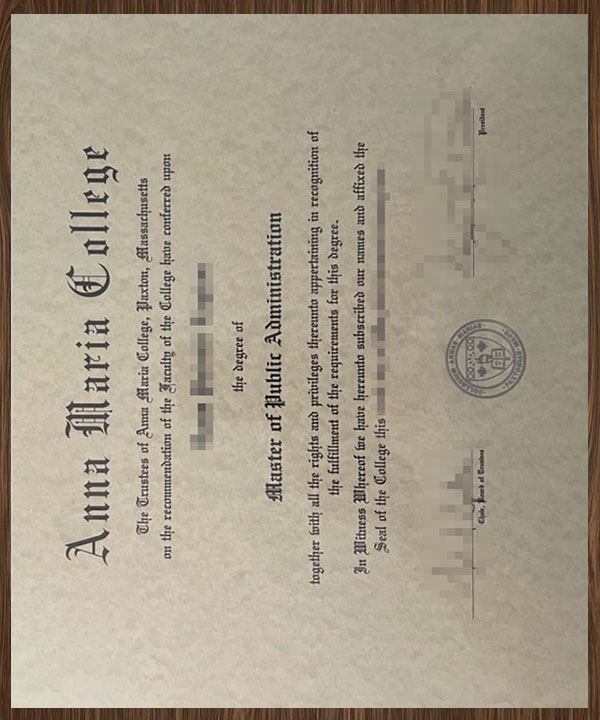
Anna Maria College presents an unusual challenge for institutional profiling: the college no longer exists in an operational sense. Founded in 1946 by the Sisters of Saint Anne in Paxton, Massachusetts, the institution served students for nearly eighty years before announcing its closure in April 2026, citing financial pressure and declining enrollment. Anna Maria College degree, Anna Maria College certificate, Anna Maria College diploma. Its final graduating class crossed the stage in May 2026, knowing they would be the last to receive degrees from the college.
This article therefore examines Anna Maria College both as it was—a small Catholic institution oriented toward community-oriented professions such as nursing, criminal justice, fire science, and social work—and as a case study in the vulnerabilities facing tuition-dependent private colleges in an era of demographic decline and financial strain. Novelty Anna Maria College degree online, Replica Anna Maria College diploma online. Understanding what Anna Maria offered, and why it could not sustain that offering, provides a instructive lens on the structural pressures reshaping American higher education.
Anna Maria College was established on September 17, 1946, as a women’s college, receiving formal approval from Richard Cushing, then Archbishop of Boston. The founding congregation, the Sisters of Saint Anne, traced their origins to Esther Blondin—known in religious life as Mother Marie Anne—who in nineteenth-century Quebec pursued a vision of empowering poor and illiterate children through education. The college’s mission statement reflects this inheritance: it sought to educate students “to become individuals who will transform their world as ethical leaders and community-oriented professionals,” grounded in Catholic intellectual tradition and a commitment to service, justice, and the development of the whole person.
The college moved from its original Marlborough campus to Paxton in 1951, establishing itself on a rural property just outside Worcester. It became coeducational in 1973 and launched graduate programs a year later. By the 2010s, Anna Maria had organized its academic offerings into schools including Business, Liberal Arts and Social Sciences, Nursing and Health Sciences, and Professional Studies, with popular programs in nursing, criminal justice, business administration, psychology, fire science, and music therapy. The college was accredited by the New England Commission on Higher Education, with program-level accreditation for Social Work and Nursing.
How to Quickly Replace a Anna Maria College degree Online?
A distinctive feature of Anna Maria’s identity was its orientation toward public safety and community health professions. Unusual ways to Get a Anna Maria College degree. The college described its community impact as measurable in “the significant number of local fire chiefs, police officers, nurses, social workers, EMTs, paramedics, forensic criminologists, and teachers” who received training there . It was recognized as a Top Five Institution for Mental Health First Aid Training, and a $1 million federal earmark supported the remodeling of its 7,000-square-foot simulation and clinical laboratories . The Molly Bish Center for the Protection of Children and the Elderly, established in 2004, further reflected this community-service orientation.
Anna Maria College’s story is not one of institutional failure in the ordinary sense. The college did what it set out to do: it educated nurses, police officers, fire chiefs, social workers, and teachers, many of them first-generation students and Pell recipients, and it did so with a explicit commitment to affordability. Its Access Scholarship was a genuine effort to make private education attainable for low-income New England students. But the financial model required to sustain that mission—tuition dependence, a small endowment, and a student body with significant financial need—proved incompatible with the demographic and economic realities of the 2020s. Anna Maria’s closure is a loss not only for its students and alumni but for the communities its graduates served. It is also a warning: the institutions most committed to access and social mobility are often the least equipped to weather financial shocks, and their disappearance narrows the pathways available to the students they were founded to serve.